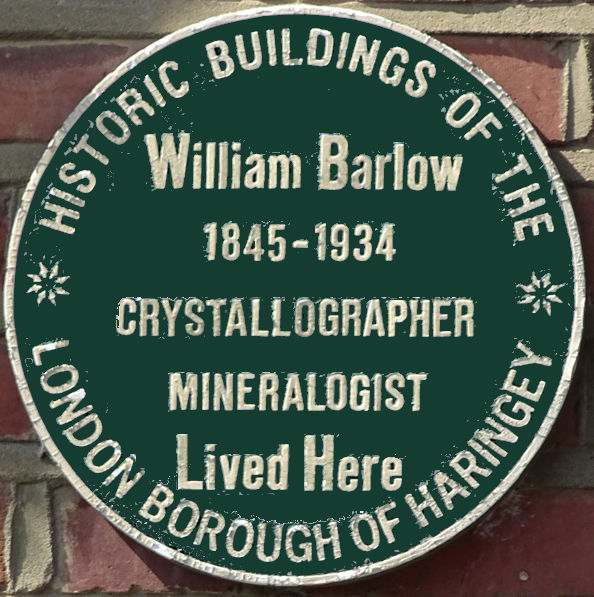
80 Muswell Hill Broadway N10
From Muswell Hill to the Moon: The Amateur Who Drew Atoms
Kelly’s 1890 Directory of Middlesex shows Barlow Wm. living at Hillfield, Muswell Hill Road – today at the corner of Hillfield Road and the Broadway. Those were the days before James Edmonson’s and W.J. Collins’s huge suburban development of Muswell Hill. From his large, detached house and spreading garden, he would have had an uninterrupted view of the railway viaduct and rolling fields. There, after a sizable inheritance from his father’s estate allowed him to stop working, he could pursue his passion: crystallography.
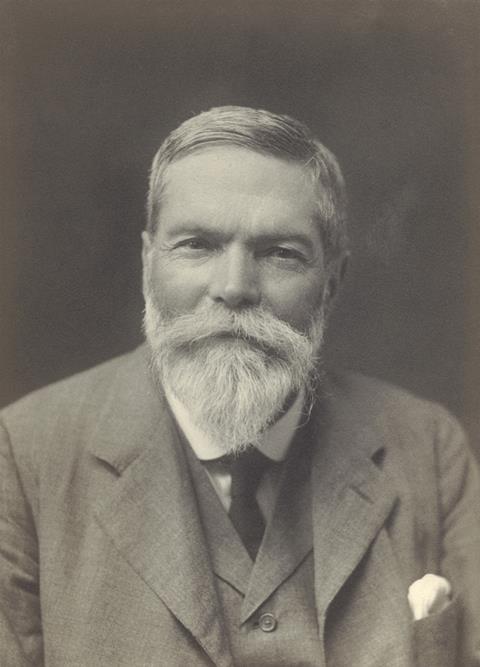
Crystallography is now a key part of life sciences, geology, and materials science. It helps us understand the structure of viruses, proteins, nucleic acids, gemstones, and many important materials. In Barlow’s time, though, it was a new and abstract field, and it was rare for amateurs to study it. Barlow was not a professional scientist; trained as a civil engineer, he had always been interested in science and math since he was a student, but he worked in the building trade before he became financially independent.
Barlow learned more about crystals after meeting Paul Groth, a leading German crystallographer, and by often attending meetings of British scientific societies. In 1883, while living in Muswell Hill, he published his first paper in the respected journal Nature, where he set out to explain the structure of crystals.
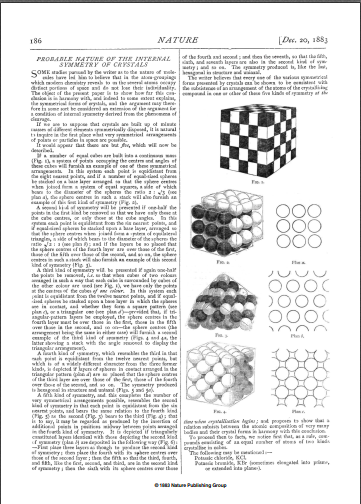
While others had reached similar conclusions through math, Barlow stood out for his visual approach. He may have been the first to use graphics, what we now call infographics, in a scientific paper to show atomic structures in three dimensions, making the information easy to understand. Even after he died in 1934, his graphics continued to appear in scientific papers and textbooks.
In the twentieth century, it was unusual for amateurs to make discoveries or become well-known in science, but William Barlow did just that. In 1908, he became a Fellow of the Royal Society, and in 1915, he was named President of the Mineralogical Society of Great Britain. Later, in 1976, a 110-kilometre-long ridge on the moon, Dorsa Barlow, was named after him, and in 2010, the mineral Barlowite was named in his honour.